
If you’ve used the internet at all in the last few years, you’ve run into ChatGPT — whether you were drafting an email, debugging code, or just testing how smart it really is. Built by OpenAI and first launched in November 2022, ChatGPT has grown from a single chatbot into a sprawling family of models, subscription tiers, and workplace tools. This guide breaks down ChatGPT in 2026: how it actually works, what it’s good at, where it still falls short, and how it stacks up against the competition.
New to ChatGPT? Start with our complete beginner’s tutorial on how to use ChatGPT before diving into what’s changed.
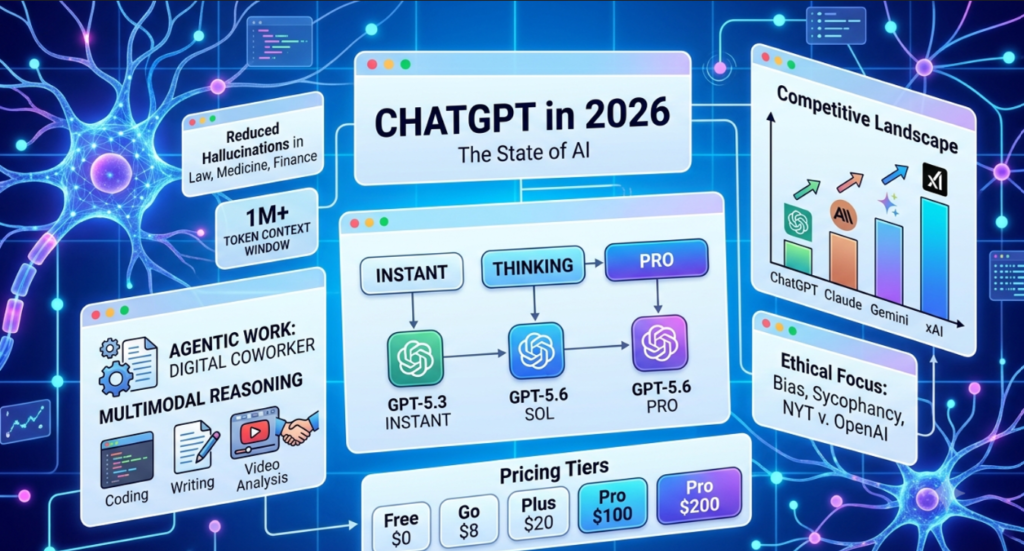
Understanding ChatGPT in 2026 means letting go of what you knew about it a year or two ago — the model lineup, the pricing, and even the way people use it day to day have all shifted significantly.
Table of Contents
How ChatGPT Actually Works ?
At its core, ChatGPT runs on a Transformer — a neural network architecture that predicts the next word (technically, the next “token”) in a sequence based on everything that came before it. The model is first pre-trained on enormous amounts of text — books, websites, code, and more — to learn the patterns of language. It’s then refined in a second stage using supervised fine-tuning and Reinforcement Learning from Human Feedback (RLHF), where human reviewers rank different responses so the model learns which answers are actually helpful, safe, and accurate.
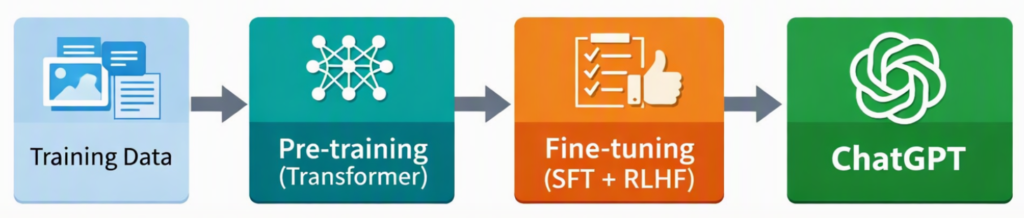
Text is broken into chunks using byte-pair encoding (BPE), a tokenization method that splits words into smaller, reusable subword pieces before the model processes them. That’s the technical foundation, and it’s held steady since the original GPT-3 days — what’s changed dramatically is everything built on top of it.
The model lineup has been completely overhauled
The early “which GPT model am I even using” confusion (GPT-4o, GPT-4.1, o1, o3, o4-mini, GPT-4.5 — all at once) is gone. This is one of the clearest signs of how different ChatGPT in 2026 feels compared to its earlier years: OpenAI simplified things into three straightforward picks in the interface — Instant, Thinking, and Pro — each mapped to a specific model tier. Older models including GPT-4o, GPT-4.1, and the original GPT-5 were retired from ChatGPT on February 13, 2026.
The full model lineup for ChatGPT in 2026 looks like this:
| Model | Released | Role |
|---|---|---|
| GPT-5.3 Instant | Early 2026 | Fast, default responses on every tier including Free |
| GPT-5.4 Thinking / Pro | Early 2026 | Deeper reasoning for paid tiers |
| GPT-5.5 Instant | May 2026 | New default; OpenAI says it cuts hallucinations in law, medicine, and finance |
| GPT-5.5 Pro | April 2026 | Available via API |
| GPT-5.6 (Sol, Terra, Luna) | July 9, 2026 | Current flagship family; Sol is the top-end “workhorse” for coding and agentic work |
Notably, GPT-5.6’s public rollout was briefly delayed: it first shipped as a limited preview to trusted partners on June 26, 2026, due to U.S. government export restrictions, before its full public launch two weeks later. The GPT-5.6 family runs a much larger context window than earlier models — around 1 million tokens on the API — a massive jump from GPT-4’s original 8K–32K token range.
One more shift worth flagging: ChatGPT now uses an auto-switching router that decides whether to answer instantly or “think” longer, rather than making users pick manually every time.
What ChatGPT Can Actually Do ?
ChatGPT’s core skill set hasn’t changed — it’s gotten broader and more capable:
- Writing and summarizing — emails, reports, essays, social copy, and document summaries across styles and tones.
- Coding — writing functions, explaining algorithms, debugging, and increasingly handling entire coding tasks semi-autonomously through OpenAI’s Codex tooling.
- Multilingual translation and Q&A — ChatGPT is available in 59 languages.
- Multimodal reasoning — analyzing images, charts, and (increasingly) audio and video inputs alongside text.
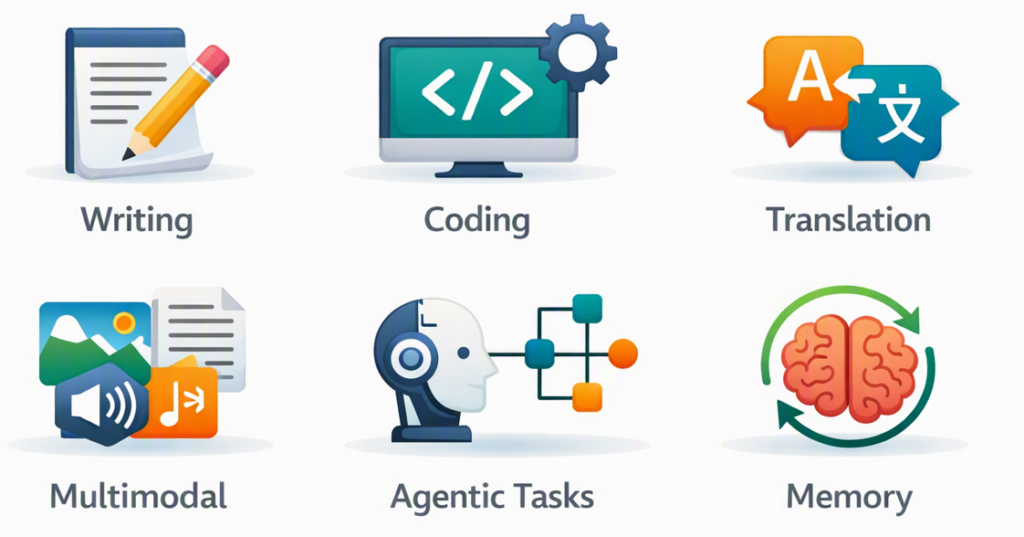
- Agentic work — this is the biggest shift since the original ChatGPT. Rather than just answering questions, current models can research online, analyze data, build spreadsheets and documents, and carry out multi-step tasks across tools until something is actually finished — closer to a digital coworker than a search-and-summarize chatbot.
- Memory and personalization — newer models can reference past conversations, uploaded files, and (for Plus/Pro users) connected services like Gmail to give more personalized answers.
Where It Still Falls Short ?
Despite the upgrades, the fundamental limitations OpenAI has long acknowledged are still real:
- Hallucination. Models can still state false information confidently, though OpenAI says newer releases like GPT-5.5 Instant reduce this meaningfully in high-stakes domains like law and medicine.
- Knowledge cutoffs. Each model’s training data is frozen at some point; anything after that requires live tools like web search.
- Bias. Because models learn from web-scale text, they can reflect the biases present in that data — something OpenAI continues to work on but hasn’t eliminated.
- Sycophancy. OpenAI has specifically called out reducing “sycophancy” — the tendency of a model to just tell users what they want to hear — as a focus area in recent releases, after user complaints about earlier models being overly agreeable.
Interestingly, the retirement of GPT-4o in February 2026 became a genuine cultural moment: many users had grown emotionally attached to its personality and pushed back hard against its removal, describing it as a “best friend” — a reminder that these are no longer just productivity tools for a lot of people.
What ChatGPT Costs Now
Pricing has expanded considerably since the early “Free vs. Plus” days. As of July 2026, there are six consumer/business tiers:
| Plan | Price | What you get |
|---|---|---|
| Free | $0 | Limited access to GPT-5.5 Instant |
| Go | $8/month | 10x more messages than Free, still lacks the top-tier model |
| Plus | $20/month | Full access to GPT-5.6 Sol, image generation, Codex, custom GPTs |
| Pro | $100/month | 5x Plus usage, GPT-5.6 Sol Pro |
| Pro | $200/month | 20x Plus usage, 1M-token context, more Deep Research runs |
| Business | ~$20–25/seat/month | Admin controls, SSO, SOC 2 compliance, no training on your data by default |
| Enterprise | Custom | Data residency, compliance controls, volume terms |
For developers, API pricing is billed separately by token. The flagship GPT-5.6 Sol model runs roughly $5 per million input tokens and $30 per million output tokens, with the cheaper Terra and Luna variants priced lower for everyday and high-volume workloads. Microsoft’s Azure OpenAI Service continues to offer the same models with enterprise-grade compliance and data residency options.
Real-World Use Cases
The practical applications have only broadened:
- Productivity — drafting, summarizing, and brainstorming remain the most common everyday uses.
- Education — OpenAI now offers dedicated plans for K–12 teachers and universities (ChatGPT for Teachers and ChatGPT Edu).
- Programming — from one-off code snippets to full agentic coding sessions via Codex.
- Customer support — companies like Spotify and Duolingo use large language models to power support and translation across dozens of languages.
- Accessibility — image description, transcription, and simplifying complex text for users with disabilities.
- Finance — a newer addition: a Personal Finance preview (US-only, Pro subscribers) launched in May 2026, connecting ChatGPT to financial accounts via Plaid.
Ethics, Privacy, and the Legal Fight That Won’t Go Away
The biggest ongoing controversy remains The New York Times v. OpenAI and Microsoft, filed in December 2023 and still very much unresolved as of mid-2026. Rather than settling, the case has intensified: in July 2026, the Times and a coalition of other newspapers formally asked the court to sanction OpenAI, alleging the company misrepresented its ability to search its own systems for evidence of copyright infringement and had deleted or made unsearchable billions of relevant ChatGPT conversations. No trial date has been set, and no company has been found liable — but some industry analysts believe a settlement, following Anthropic’s earlier author settlement, is increasingly plausible for OpenAI as well.
On the privacy side, the ground rules are fairly consistent with prior years: content from Free, Go, Plus, and Pro accounts can be used to improve OpenAI’s models unless a user opts out, while Business and Enterprise accounts are excluded from training by default.
The Competitive Landscape
ChatGPT in 2026 is no longer competing in a category of one. As of late July 2026:
- Anthropic’s Claude just released Claude Opus 5 (July 24, 2026), which took the top spot on multiple independent intelligence benchmarks at launch, alongside the Claude 5 family including Sonnet 5 and the higher-tier Mythos-class models.
- Google’s Gemini continues rapid iteration, with the Gemini 3.x line adding stronger multimodal and video capabilities.
- xAI’s Grok and Meta’s Llama/Muse models have both pushed further into cheap, developer-friendly territory — Meta began charging for API access to its models for the first time in July 2026.
- Open-weight models from labs like DeepSeek and Mistral continue to close the capability gap at a fraction of the cost, reshaping how enterprises think about build-vs-buy decisions.
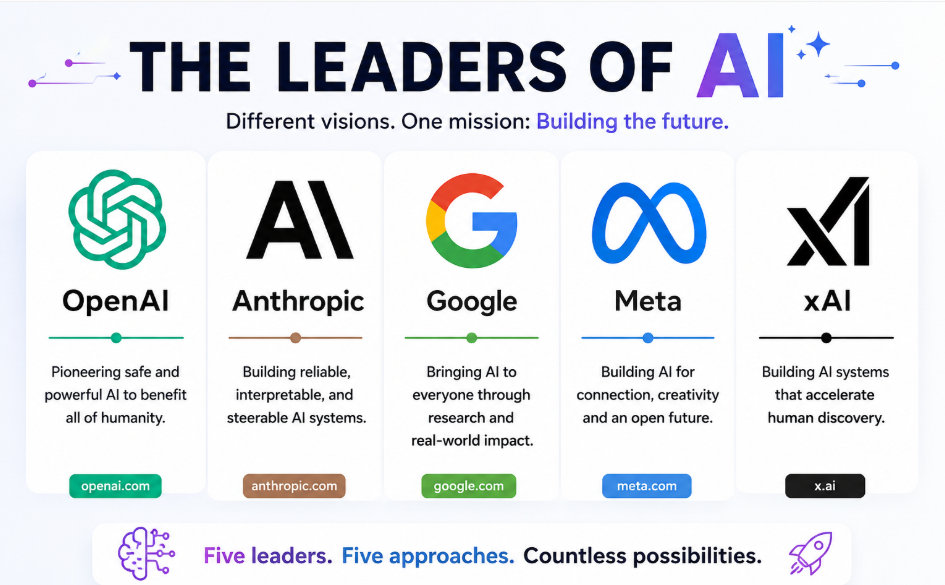
The upshot: 2026 has turned into one of the most competitive stretches in AI so far, with major flagship releases from nearly every big lab landing within weeks of each other.
What’s Next
Expect the trend lines from the past year to keep extending: larger context windows, deeper agentic capabilities (models that don’t just answer but complete multi-step work), tighter integration into everyday software like spreadsheets and email, and continued jockeying between OpenAI, Anthropic, and Google for the top benchmark spot. The regulatory and copyright questions — training data rights, content licensing, AI safety oversight — remain unsettled and will likely shape how aggressively these companies can expand over the next year.

Bookmarking this for later. Creators might like Happy Shrimp here: /. Happy Shrimp