
Anthropic shipped Claude Opus 5 on July 24, 2026 — its fourth frontier release in under two months, hot on the heels of Mythos 5, Fable 5, and Sonnet 5 in June. The pitch: near-Fable intelligence at half the price. That’s the kind of claim that makes developers sit up.

So does it deliver? After digging through hands-on developer impressions — not just benchmark charts — the honest answer is: sort of, with an asterisk the size of a whiteboard. Claude Opus 5 is genuinely talented, but it also has some baffling personality quirks. Think brilliant intern who occasionally reorganizes your entire desk when you asked them to move one pen.
Table of Contents
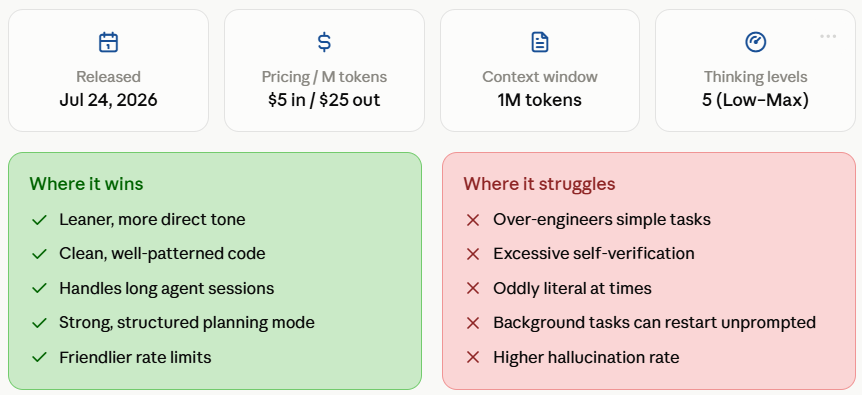
Quick Facts: Claude Opus 5 at a Glance
| Spec | Details |
|---|---|
| Release date | July 24, 2026 |
| Pricing | $5 / million input tokens, $25 / million output tokens (same as Opus 4.8) |
| Context window | 1 million tokens |
| Max output | ~128,000 tokens |
| Thinking levels | Low, Medium, High, Extra, Max |
| Default on | Claude Max (default), Claude Pro (top option) |
| Positioning | Near-Fable 5 performance at ~half the cost |
| Weak spots | Offensive cybersecurity, longest-horizon autonomous tasks |
Where Claude Opus 5 Actually Impresses
- Leaner personality — blunter and faster than other Claude models, less preamble, more “just do the thing”
- Clean code output — sensible architecture, service composition that makes sense, patterns that match your existing codebase instead of generic boilerplate
- Handles long agentic sessions well — sub-agent workflows hold together without collapsing
- Friendlier on rate limits — noticeably less punishing than heavier models
- Strong planning mode — pulls in reference repos, runs sub-agents to chase edge cases, and asks clarifying questions in tidy batches instead of a wall of 20 questions at once
Want to get more out of Claude? Most people barely scratch the surface. In Claude AI Hacks: 16 Features 99% of Users Are Missing, we break down the tools that turn Claude from a basic chatbot into a real productivity system — including Cowork background automation, Gmail and Calendar connectors, and skills that run repeatable tasks on their own.
Where It Gets Weird
- Overthinks small tasks — a 50-line fix can balloon into a 500-line diff padded with unrequested tests and scope creep
- Verification overkill — runs full test suites, spins up browser sessions, and writes unit tests even for trivial one-line commits
- Oddly literal at times — refused to push already-staged code because pushing “wasn’t explicitly stated,” even though it clearly was implied
- Background processes waking up mid-review — work quietly resumes after the user thought a session was done
- Higher hallucination rate — more willing to answer confidently instead of admitting uncertainty on knowledge tasks
Claude Opus 5 vs. Fable 5 vs. Opus 4.8
| Claude Opus 5 | Fable 5 | Opus 4.8 | |
|---|---|---|---|
| Best for | Well-scoped, everyday coding tasks | Ambiguous, foundational, long-horizon work | Predecessor — now largely superseded |
| Cost | $5 / $25 per M tokens | Higher | Same as Opus 5 |
| Code polish | Very good | Best-in-class | Good |
| Autonomy on hard tasks | Good, but needs supervision | Excellent, can run for days | Moderate |
| Tendency to over-engineer | High | Low | Low-moderate |
| Ideal use case | Defined refactors, scoped PRs, sub-agent tasks | Architecture, ambiguous multi-day builds | Legacy workflows |
So, Should You Actually Use It?
Use Claude Opus 5 if:
- Your task has a clear spec and narrow scope
- You want frontier-adjacent code quality without frontier-level cost
- You’re comfortable actively constraining scope in your prompts
Stick with Fable 5 if:
- The task is exploratory or ambiguous
- You need a model that runs autonomously for days with minimal oversight
- Judgment about when to stop matters more than raw output
Pro tip: Use the effort dial. Dropping to a lower thinking level for simple tasks noticeably calms down the “let me also refactor your entire auth system” instinct.
New to Claude? Start with the basics before diving into advanced workflows. 7 Claude AI Features That Make You 10x More Productive walks through Artifacts, Skills, Projects, and the AIM prompting framework — everything you need to actually use Claude like a pro, not just chat with it.
Bottom Line
Claude Opus 5 earns its hype in real ways — sharper code, a leaner personality, and a price tag that makes frontier-adjacent intelligence affordable for daily use. But it’s not plug-and-play: rein in its scope, or a simple commit can spiral into a weekend project. It’s a genuinely good model with some genuinely strange habits — and for teams willing to write tight prompts, that trade-off is well worth making.

Claro y práctico. Prueba The Choicer Voicer: . The Choicer Voicer
This answered my questions. Also recommend Luna Lisa Alpha: for image generate plus instruction edits.. Luna Lisa Alpha