
AI news this week is packed with 16 updates that every tech-forward person should know about. From a free Chinese model challenging the world’s best AI, to a major lawsuit shaking Anthropic, to an image company building a body scanner — here’s everything that matters.
1. AI News This Week: GLM 5.2 Takes On the Best
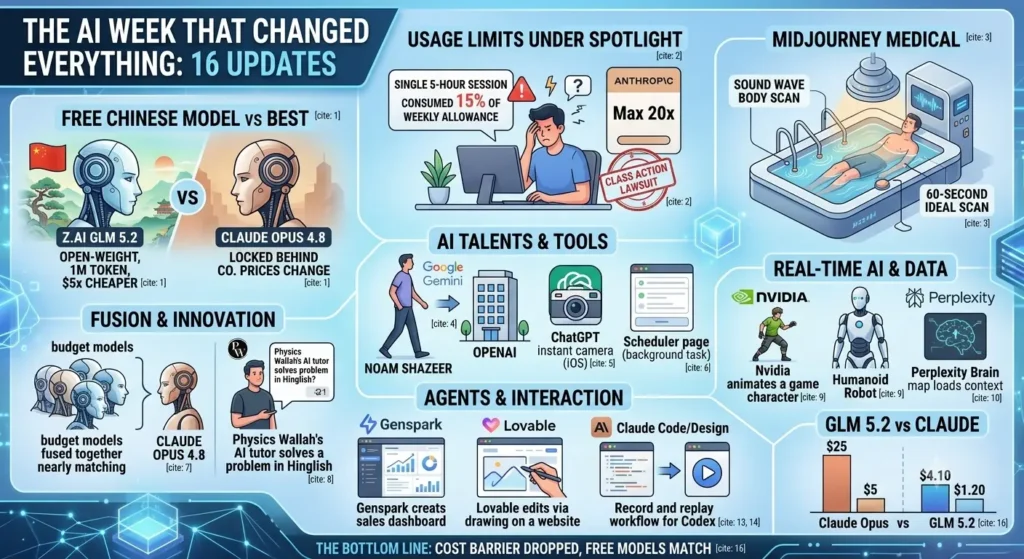
A Chinese company called Z.AI released GLM 5.2, an open-weight model that ranked second best in blind testing — beaten only by Claude Opus 4.8. The real story isn’t just the performance. It’s the freedom.
Most top AI models are locked behind their companies. Prices change, rules shift, and access can be cut off. GLM 5.2 is different. Anyone can download it, run it on their own machine, and nobody can shut it off or ban it. It holds a 1 million token memory, comes with an MIT license (free for businesses too), and costs roughly five times less than comparable models.
One important caveat: using it through Z.AI’s cloud sends your data to servers in China. If privacy is a concern, the open-weight nature of the model means you can run it entirely on your own machine using a tool called Ollama — nothing ever leaves your computer.
2. This Week in AI News: Anthropic Faces Lawsuit
A customer named Carl Khan signed up for Anthropic’s Max 5x and Max 20x plans, expecting five or twenty times the usage of a standard Pro plan. What he actually received, according to his lawsuit, was far less — a single five-hour session consumed 15% of his entire weekly allowance on a $200 plan.
The case has been filed in California with the aim of becoming a class action. Anthropic declined to comment. This case matters beyond one customer’s frustration — a ruling could force the entire AI industry to be far more transparent about exactly what you’re getting before you pay.
3. MidJourney Is Building a Body Scanner
The company behind AI-generated images just announced Midjourney Medical — and it’s hardware. The scanner lowers you into a shallow pool of warm water while thousands of tiny sensors scan your entire body using sound waves. No claustrophobic MRI machines. The experience is designed to feel more like a spa than a hospital.
The vision: a 60-second scan for a few dollars, with 50,000 of these worldwide. The current reality is more measured — scans take around 20 minutes, FDA approval is pending, and it remains a prototype. The founder’s reasoning is bold: AI image generation earns enough to fund moonshots like this.
4. The “Founding Father” of Modern AI Moves to OpenAI
AI news this week highlights Noam Shazeer — one of the co-authors of the landmark 2017 paper Attention Is All You Need, which laid the foundation for essentially every major AI model today — has left Google for OpenAI. Google had paid approximately $2.7 billion to bring Shazeer back in 2024 and put it in charge of Gemini. Less than two years later, it walked out the door and into their biggest rival. OpenAI has made Shazeer head of architecture research, putting it in charge of how future models are built from the ground up.
5. ChatGPT Gets an Instant Camera
Uploading a photo in the ChatGPT iOS app is now instant — tap the camera, point it at whatever you need help with, and get an answer without any loading lag. The photo lands in chat immediately. Android users are still waiting for their turn.
6. ChatGPT Can Now Schedule Tasks
ChatGPT can work in the background without waiting for you. Set a task once — “the day before every Portugal match, send me a scouting report on the other team” — and it runs automatically on schedule. A new dedicated scheduled tasks page lets you manage everything in one place.
7. OpenRouter Fusion: Frontier Performance at Half the Price
Since Claude Opus 4.8 was restricted outside the US, people have been hunting for equivalent intelligence. OpenRouter’s new Fusion feature runs the same task across multiple AI models simultaneously and combines the outputs — where one model is weak, another covers for it. In testing across 93 tasks, a panel of four budget models fused together nearly matched Claude Opus 4.8 at roughly half the price.
8. Physics Wallah Gives Its AI Tutor a Voice
AI news this week says India’s Physics Wallah — used by 36 million students — gave its AI doubt-solving feature a voice that speaks in Hinglish, the Hindi-English blend most Indian students naturally use. A student scribbles a problem on a digital blackboard, and the AI reads the handwriting and explains the solution out loud, step by step. The result: students asked three times more questions per session and stayed 2.4 times longer within two weeks.
9. Nvidia Builds AI That Animates Game Characters in Real Time
As per AI news this week Nvidia’s Motion Bricks is an AI that generates character movements on the fly — no animator required. A character navigates a space, picks up a weapon, vaults over obstacles, and switches between movement styles, with every frame generated live. The same system also powers Nvidia’s humanoid robots, meaning the brain behind a game character’s motion is the same one running a real robot’s body.
10. Perplexity Brain Remembers Your Work
Perplexity launched Brain, a persistent memory layer that quietly builds a map of everything you’ve worked on. Every new task starts with all that context already loaded in — your docs, your channels, your past approaches. Second-time tasks are completed 25% more accurately, the AI retains more of what matters, and tasks run 13% cheaper.
11. Genspark Agentbase Replaces Your App Stack
Genspark’s Agentbase lets you describe a tool in one sentence and get a fully working system back says AI news this week. Ask it to build a sales dashboard, and it pulls your real data, generates charts, revenue numbers, and win rates, all in one place. It replaces the scattered stack of disconnected apps that most teams patch together — and it updates on the fly as you talk to it.
12. Lovable Lets You Edit by Drawing
Lovable — which lets you build full apps and websites by typing prompts — added a visual editing mode. You can now scribble directly on your live website: cross out a button you don’t want, circle something to change, draw an arrow to move a section. The AI reads your marks and makes the edits. Comments and teammate tagging are included too.
13. Claude Design Gets Smarter and More Connected
AI news this week says Claude Design now automatically picks up your existing brand colors, fonts, and style when you point it at your website or design files. You can also edit directly on the canvas by clicking, moving, and resizing elements without typing out every change. Claude Design and Claude Code now work together in one continuous flow — design, build, and iterate without starting over. Finished designs can be exported to PDF, PowerPoint, or sent directly to Replit to become a live working app.
14. Claude Code Creates Live Shareable Dashboards
Claude Code can now turn its work into a live shared page. When it analyzes data or fixes a bug, it can build a dashboard your entire team can open on their phones. As Claude Code keeps working and updating the code, that same page refreshes in real time — turning every coding session into something the whole team can follow without needing a separate briefing.
15. OpenAI Codex Learns by Watching
As per AI news this week OpenAI’s Codex introduced Record and Replay. Record yourself performing a workflow once — uploading a video, filling out a form, navigating a tool — and Codex watches the entire process and converts it into a reusable skill. Next time, just tell it to run the task, and it executes every step on its own. You can review what it learned and edit the skill if needed. Teach it once, and it handles it from then on.
16. GLM 5.2 vs. Claude: The Head-to-Head Result
In AI news this week, direct testing using identical prompts across three categories — an interactive AI learning roadmap website, a visually animated product page, and a fully playable 2D action game — GLM 5.2 held its ground against Claude Opus 4.8 and Claude Fable 5. On interactivity and moving parts, GLM 5.2 often came out ahead. On polish and narrative quality, Claude Fable 5 shone. Claude Opus 4.8, the older model, lagged behind both in most tests. The cost comparison tells the sharpest story: Opus 4.8 costs $5 to read and $25 to write per million tokens. GLM 5.2 does the same for $1.20 and $4.10 — roughly five times cheaper for comparable output.
The Bottom Line
A year ago, building something polished required paying for the most expensive model available. Today, as this week’s AI news proves, a free open-weight model is matching it. The cost barrier that kept many people from building websites, apps, and tools has meaningfully dropped. Stay updated with the latest AI news this week — because the competition is real, the options are expanding, and the pace shows no sign of slowing.

1 thought on “AI News This Week: 16 Shocking Updates That Change Everything in 2026”