
If you have ever needed to move a file from your laptop to your phone without emailing it to yourself or plugging in a cable, ShareDrop is still a handy tool to know about. ShareDrop is a free, browser-based file-sharing app, and it is now owned by LimeWire, which has changed how the upload and sharing process actually works. This guide explains what ShareDrop is today and walks through a complete step-by-step tutorial for uploading and sharing a file or folder.
What Is ShareDrop?
ShareDrop started out as a free, open-source web app that let people share files directly between devices using WebRTC (Web Real-Time Communication), a browser technology that creates encrypted, direct connections without routing files through a server. ShareDrop is owned by LimeWire now, a company known for file sharing and AI tools, and the two brands are merged in the current interface — the upload screen displays “ShareDrop by LimeWire” branding, and after you upload a file, you are redirected to limewire.com to manage and share it.
This ownership change means ShareDrop today is best described as a LimeWire-branded front door: the initial upload screen still looks like the classic AirDrop-style ShareDrop page, but the actual file hosting, link generation, and sharing options now run through LimeWire’s platform rather than a pure device-to-device WebRTC handoff.
Key Features Today
- Familiar upload screen – The sharedrop.io page still shows the original “Upload Files” / “Upload Folder” circular interface, now labeled “ShareDrop by LimeWire.”
- Cloud-backed sharing – Once you upload, files are hosted through LimeWire rather than staying strictly peer-to-peer, so a shareable link is generated automatically.
- Multiple ways to share – You can share a file via a direct download link, a QR code, email, or to a nearby device on the same Wi-Fi network.
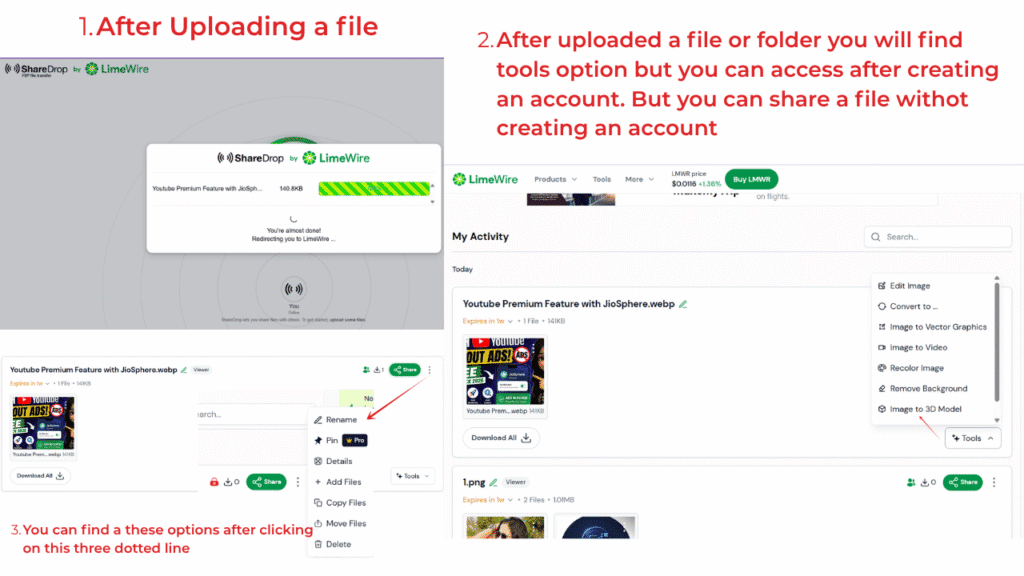
- Expiring links – Uploaded files show an expiration window (for example, “Expires in 1w”) rather than staying available indefinitely.
- Permission controls – You can set link permissions, such as “View & Download only,” before sharing.
- Free tier with ads – The LimeWire results page includes sponsored ads and a live LMWR token price ticker, since LimeWire also runs a cryptocurrency project.
Is It Safe to Use?
It is still reasonably safe to use, but the safety profile has shifted since the LimeWire acquisition. In the original design, files never touched a server. In the current version, uploaded files are stored on LimeWire’s platform for a limited time (shown as an expiration date on the share screen), and sharing options include a public link, QR code, and email delivery. The interface itself notes that emailing a download link breaks end-to-end encryption, so for the most private transfer, use the “Share Nearby” option to send directly to another device on the same network, or generate a link and share it only through a channel you trust.
Table of Contents
How to Use ShareDrop: Step-by-Step Guide
Here is the current, accurate walkthrough for uploading and sharing a file or folder.
Step 1: Open the Site
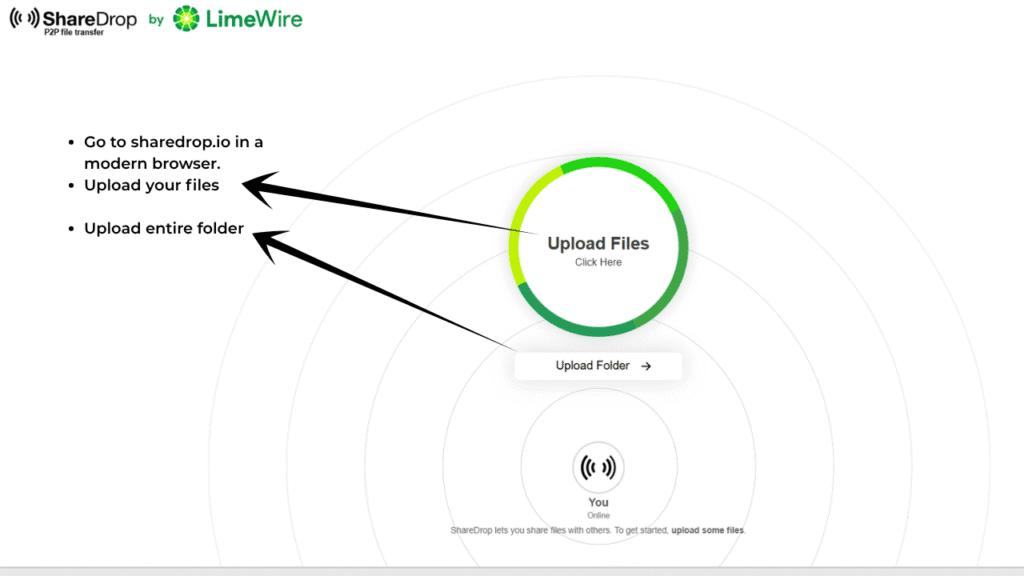
Go to sharedrop.io in a modern browser. You will see the “ShareDrop by LimeWire” branding at the top of the page, along with the familiar circular “Upload Files” button and an “Upload Folder” option below it.
Step 2: Upload a File or Folder
Click Upload Files and select the file (or files) you want to share, or click Upload Folder to select an entire folder at once. A progress window appears showing each file’s name, size, and upload percentage while it processes.
Step 3: Wait for the Upload to Finish
Once the upload completes, It redirects you to limewire.com with a confirmation message: “Your files are ready! Sharedrop.io is now part of LimeWire.” Your uploaded files appear as thumbnails, along with details like file count, total size, and how long the files will remain available (for example, “Expires in 1w”).
Step 4: Choose How to Share
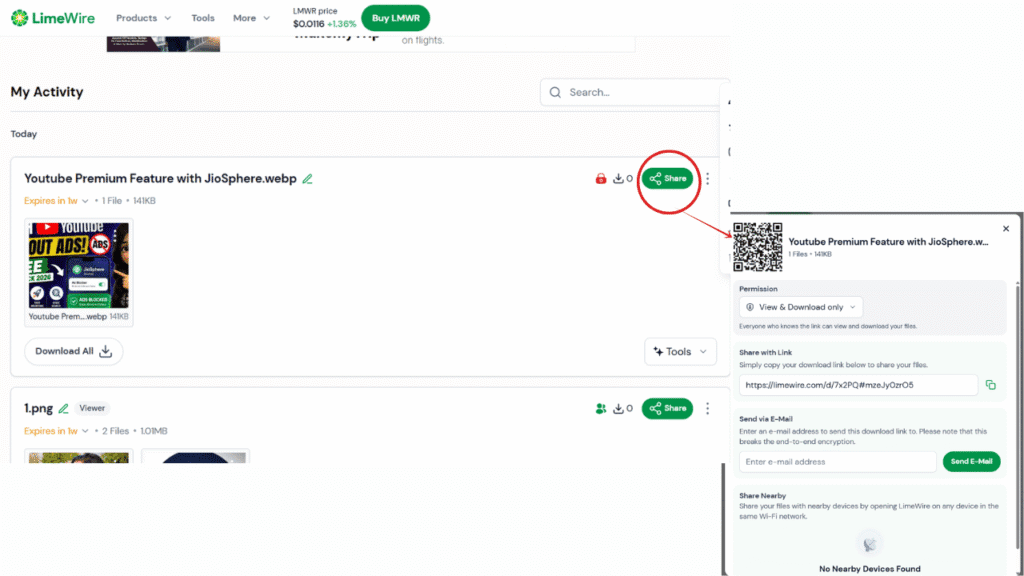
Click the green Share button next to your uploaded file. A panel opens with several sharing options:
- Share with Link – Copy a direct download URL to paste anywhere.
- Send via E-Mail – Enter a recipient’s email address and LimeWire sends the link for you (note: this breaks end-to-end encryption).
- Share Nearby – Open limewire.com on another device on the same Wi-Fi network to send the file directly, similar to the original ShareDrop experience. A QR code is also shown here so a phone can scan it to open the same link instantly.
Step 5: Set Permissions and Send
Before sharing, check the Permission dropdown (for example, “View & Download only”) to control what recipients can do with the file. Then share the link, QR code, or email as needed. The recipient opens the link and can view or download the file directly from LimeWire, no account required on their end.
Pros and Cons
Pros:
- Still free to use with no account required to upload or download
- Multiple sharing methods: link, QR code, email, or nearby device
- Familiar, simple upload interface
- Works across desktop and mobile browsers
Cons:
- No longer purely peer-to-peer — files are hosted on LimeWire’s platform for a limited time
- Ads appear on the LimeWire results page
- Emailing a link breaks end-to-end encryption
- Files expire after a set period rather than transferring once and disappearing from any server
ShareDrop Alternatives
If you want a file-sharing tool closer to the original pure peer-to-peer model, Snapdrop and PairDrop are both open-source alternatives that keep transfers device-to-device without redirecting to a separate cloud platform. Some other file transfer tools which are free to use are https://toffeeshare.com/, http://www.filedropme.com/, https://justbeamit.com/, https://www.linshare.org/.
Frequently Asked Questions
Is ShareDrop still free? Yes, uploading and sharing files through ShareDrop remains free, though the LimeWire platform it now runs on does display ads and promote a paid tier with more storage.
Does ShareDrop still work directly between devices without uploading to a server? Only through the “Share Nearby” option, which connects two devices on the same Wi-Fi network. Using a link, QR code, or email instead routes the file through LimeWire’s hosting.
Who owns ShareDrop now? ShareDrop is owned by LimeWire. The sharedrop.io upload page displays “ShareDrop by LimeWire” branding, and completed uploads redirect to limewire.com for sharing and management.
Do shared files expire? Yes, uploaded files display an expiration window (such as “Expires in 1w”) rather than remaining available indefinitely.
Final Thoughts
ShareDrop has changed since its original release: it is now owned by LimeWire, and uploads are hosted on LimeWire’s platform with expiring links rather than staying strictly device-to-device. The upload experience is still quick and free, and the “Share Nearby” option preserves the original local-network sharing feel, but it is worth knowing that a public link, QR code, or email share now depends on LimeWire’s hosting rather than a direct browser-to-browser connection. Use the option that best matches how private you need the transfer to be.

Very soon this web page will be famous amid all blogging and site-building users, due to
it’s nice content
What’s up to every one, it’s genuinely a pleasant
for me to pay a quick visit this website, it contains
important Information.